Spec Governance
Flexibly define the rules and practices for managing living specs in a spec-driven development setup. Every team is different—Specularis lets you set the structure, conventions, and workflows that fit how you actually work.
Key Features
Your Structure, Your Rules
✓
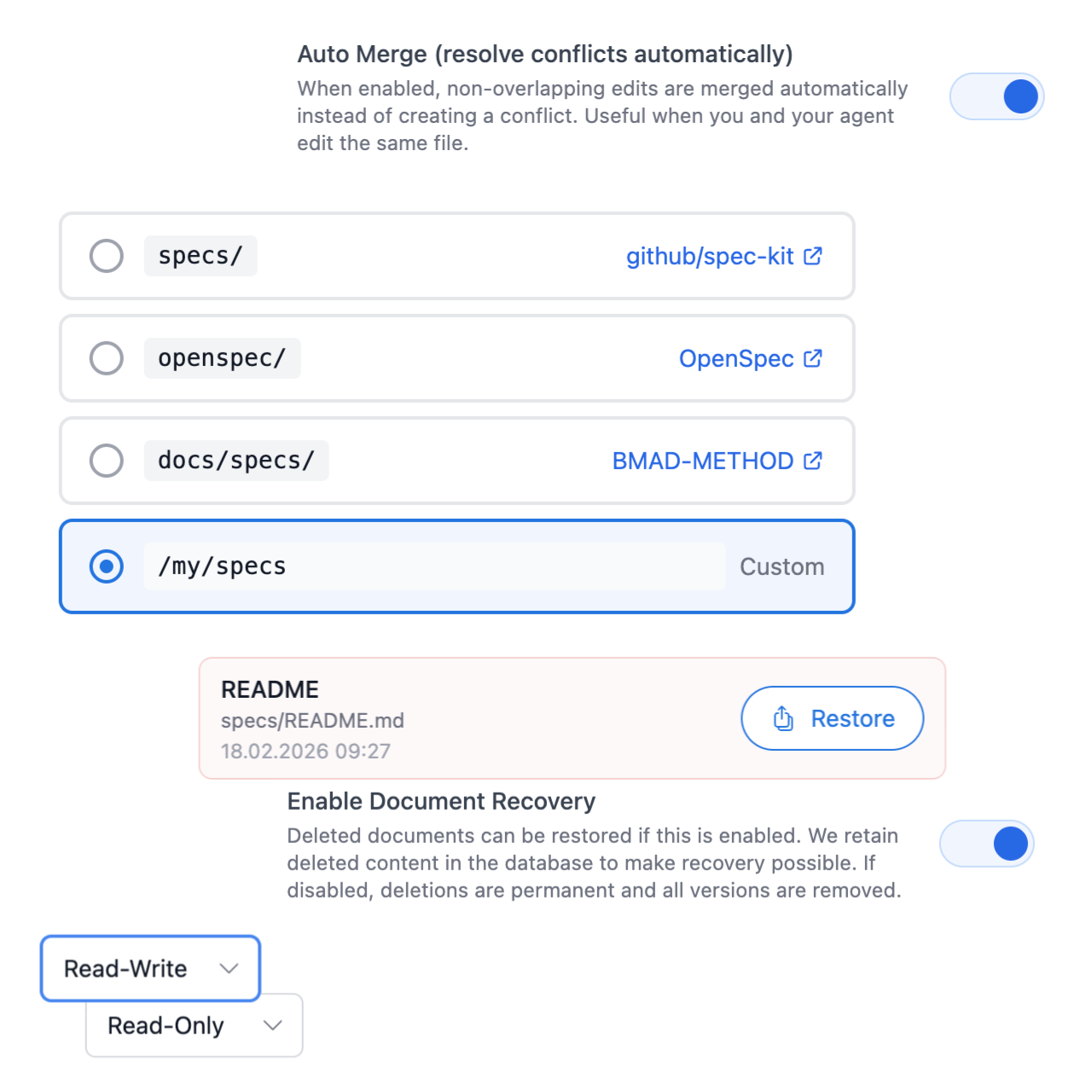
Configurable specs path
Name your folder what fits—specs, openspec, docs. The system adapts to your project layout, not the other way around.
✓
Conventions you choose
Numbered feature folders, spec.md/plan.md/tasks.md—adopt what works. Checklists and contracts in subfolders when you need them.
✓
Spec toolkit agnostic
The Specularis layer adapts to whatever spec toolkit or framework you choose—and whatever toolkit your code agent is prepared for. GitHub's spec-kit, OpenSpec, commercial third-party, or custom. Sync and governance work regardless.
✓
Clear file organization
Define where core specs live vs agent output. _chat/ for analysis and comparisons—keeps structure predictable for humans and agents.
✓
Agent rules from your setup
Connect your agent—rules are generated from your structure and conventions. Agents follow the practices you define.
Living Specs, Governed Evolution
✓
Full version history
Every change is tracked. Compare any two versions, restore any previous state. Governance includes knowing exactly what changed and when.
✓
DAG versioning—no overwrites
Concurrent edits create branches, not overwrites. Your governance model decides how to merge—resolve conflicts in the web app.
✓
Author attribution
See who made each change—you, your agent, or the system. Practices that rely on provenance stay enforceable.
✓
Conflict resolution in one place
Conflicts resolved in the web app. No scattered .conflict files—a single, clear practice for handling divergent edits.
Practices That Scale With You
✓
Start simple
Flat structure, minimal conventions—whatever fits early exploration. Add governance when the project matures.
✓
Add structure when ready
Numbered folders, checklists, contracts—introduce them as needed. No big migration, no lock-in to one rigid model.
✓
Workspace per project
Clear boundaries—one workspace per project. Govern specs within each project's scope without cross-contamination.
✓
Sync rules that match your workflow
Bidirectional sync, hash-first protocol. Specs stay current in the web app and locally—governance without friction.
Use Cases
Teams with different maturity levels
Startups need flexibility; enterprises need guardrails. Define the rules that fit your stage—structure evolves with you.
Spec-driven workflows without rigidity
Specs as source of truth, but your conventions. Numbered folders or flat—checklists or ad-hoc—you choose.
Living specs that evolve with the codebase
Specs change as the system changes. Governance defines how: versioning, conflict resolution, provenance—all under your control.
Using your preferred spec toolkit
The Specularis layer adapts to your chosen spec toolkit or framework and to whatever toolkit your code agent uses. GitHub's spec-kit, OpenSpec, commercial third-party, or custom—sync and governance work regardless.
Humans and agents aligned by clear rules
Agent rules reflect your structure and practices. Everyone knows where things go and how changes flow—less guesswork, more consistency.